- Best for books and long manuscripts: ProWritingAid — far deeper reports than Grammarly, built for 80,000 words not 800.
- Best cheap alternative: LanguageTool — multilingual, privacy-friendly, and roughly half Grammarly’s price.
- Best free: Hemingway for readability, or a chatbot for rewriting. Both cost nothing.
- Reality check: Grammarly Pro is $12/month as of August 2026. Several “cheaper alternatives” are not actually cheaper once you compare properly.
- The real reason to switch is usually privacy, price in your currency, or manuscript-length work — not accuracy.
Most people looking for Grammarly alternatives want one of four things: a lower price, a tool that handles book-length manuscripts, support for a language other than English, or a privacy posture that lets them run it on client and legal work.
Grammarly is genuinely good at what it does, so the honest framing is not “what beats it” but “what fits the case it does not”. Part of our AI writing tools hub.
What Grammarly actually costs
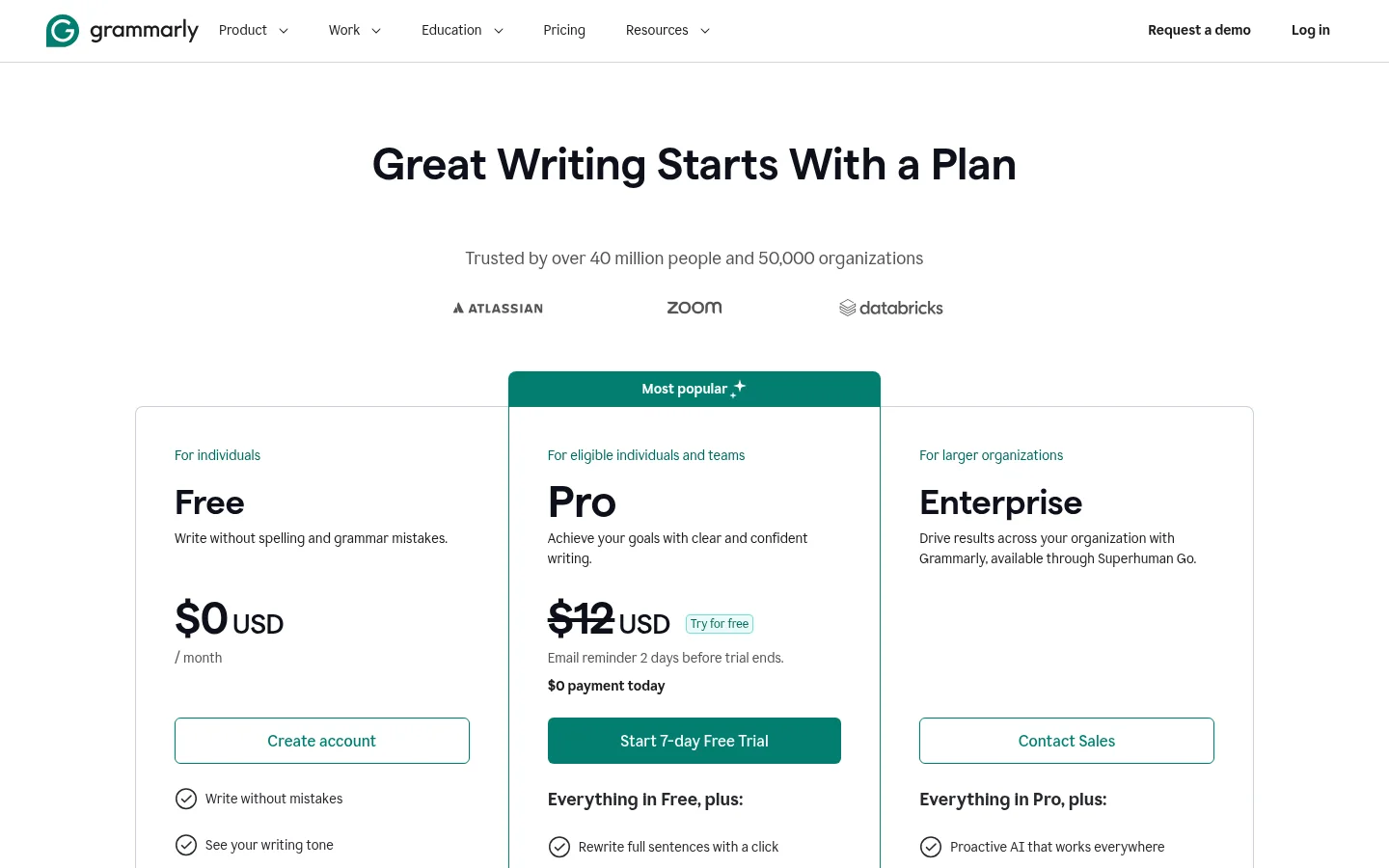
Worth establishing before comparing: as of August 2026, Grammarly is Free at $0/month, Pro at $12/month (with a 7-day free trial and no payment up front), and Enterprise at custom pricing. Its free tier covers spelling, grammar and basic tone.
That $12 figure matters, because a lot of “cheaper alternative” content is written against an older, higher price. Several tools below are not meaningfully cheaper. See our Grammarly review for the full picture.
The best Grammarly alternatives compared
| Tool | Best for | Free tier | Price (Aug 2026) |
|---|---|---|---|
| ProWritingAid | Books, manuscripts, deep reports | Limited | Subscription or lifetime licence |
| LanguageTool | Multilingual, privacy, value | Yes (generous) | ~$5/mo equivalent (~$59.90/yr) |
| Hemingway Editor | Readability and sentence bloat | Yes (web) | One-time desktop purchase |
| QuillBot | Paraphrasing and rewriting | Yes | ~$8.33/mo annual |
| Claude / ChatGPT | Rewriting with judgement | Yes | Free tiers usable |
| Wordtune | Sentence-level rephrasing | Yes | Subscription |
| AutoCrit | Fiction-specific editing | Trial | ~$180/yr |
1. ProWritingAid — best for long-form and books
This is the substantive upgrade rather than a cheaper substitute. ProWritingAid produces manuscript-level analysis Grammarly does not attempt: pacing, sticky sentences, echoes, overused words, dialogue tags, sentence-length variety, readability by chapter. It is the tool that tells you that you used “just” 340 times.
It also offers a lifetime licence, which for a multi-year project is often cheaper than any subscription here.
Skip it if you write emails and short business copy. The reports are overwhelming for a 300-word document, and Grammarly is faster for that job.
2. LanguageTool — best value and best for other languages
LanguageTool checks more than 30 languages, has a genuinely generous free tier, and Premium runs around $59.90 a year — roughly $5 a month, less than half Grammarly Pro.
Its other advantage is posture: it is EU-based with a stronger privacy stance and self-hosting options, which is why it shows up in agencies, law firms and anywhere client text cannot go through a US SaaS by default.
Skip it if you want the most polished writing suggestions in English. Grammarly’s rewrite quality and app coverage are still ahead — LanguageTool has fewer integrations, which is the most common complaint from switchers.
3. Hemingway Editor — best free, and best at one thing
Hemingway does not check grammar. It highlights long sentences, passive voice, adverbs and complex phrasing, and gives you a reading grade. That is the whole product, it is free in the browser, and it fixes the most common problem in business writing: sentences nobody wants to read.
Skip it if you need actual proofreading. Pair it with something else rather than replacing Grammarly with it.
4. QuillBot and Wordtune — best for rewriting
Both are rephrasing tools rather than checkers. Paste a clumsy sentence and get several cleaner versions with control over formality and length. QuillBot is around $8.33/month billed annually and bundles a summariser, plagiarism checker and AI detector; Wordtune is narrower and smoother at sentence-level suggestions.
See our QuillBot review and AI rewriter guide.
5. Claude or ChatGPT — the free alternative most people overlook
Paste your text and ask for a proofread, a tone change, or an explanation of what is weak about it. A chatbot does not run inline as you type — that is the real trade — but it applies judgement Grammarly cannot: it understands what you were trying to say, not just whether the sentence is well-formed.
Both have usable free tiers. For anyone editing a handful of documents a week rather than writing all day, this genuinely replaces a subscription. See best AI for writing.
6. AutoCrit — best for fiction
Fiction-specific editing: dialogue balance, pacing by scene, showing-versus-telling, and comparison against published books in your genre. Around $180/year. Genuinely useful for novelists and pointless for anyone else.
Which alternative fits your reason for leaving?
- “It’s too expensive”: LanguageTool, or a chatbot free tier. Note Grammarly Pro is $12/month — check you are actually saving.
- “I’m editing a book”: ProWritingAid, ideally the lifetime licence.
- “I don’t write in English”: LanguageTool.
- “My clients’ text can’t go to a US SaaS”: LanguageTool with self-hosting.
- “My writing is too dense”: Hemingway, free.
- “I want sentences rewritten, not corrected”: QuillBot, Wordtune or a chatbot.
- “I write fiction”: AutoCrit or ProWritingAid.
- “It keeps flattening my voice”: that is every tool in this category. Accept fewer suggestions rather than switching.
Two things to check before you switch
App coverage. Grammarly’s real advantage is that it works nearly everywhere you type — browser, desktop, mobile keyboard, Word, email. This is the most common regret among switchers: the alternative is better on paper and worse in practice because it does not run where you write. Confirm your daily apps are supported before you cancel.
What happens to your text. All of these send your writing to a server. If you handle client, legal, medical or unpublished commercial material, check the retention and training policy — and prefer a self-hostable option like LanguageTool if the answer matters.
Bottom line
ProWritingAid if you are editing something book-length. LanguageTool if you want to pay less, write in another language, or keep your text in Europe. Hemingway free if the problem is dense prose, and a chatbot free tier if you edit occasionally. But at $12/month with the widest app coverage in the category, Grammarly is not the obvious rip-off some comparisons imply — switch for a specific reason, not on price alone.
More in the AI writing tools hub, or see best AI tools for writers.
FAQ
What is the best Grammarly alternative? ProWritingAid for books and long manuscripts, LanguageTool for value and non-English writing, Hemingway for readability, and a chatbot like Claude or ChatGPT for rewriting with judgement. The right one depends on why you are leaving.
Is there a free Grammarly alternative? Yes. LanguageTool has a generous free tier, Hemingway Editor is free in the browser, and Claude and ChatGPT will proofread and rewrite on their free plans. Grammarly’s own free tier is also usable.
How much does Grammarly cost in 2026? Free at $0, Pro at $12 per month with a 7-day free trial and no payment up front, and Enterprise at custom pricing.
Is ProWritingAid better than Grammarly? For manuscript-length work, yes — its pacing, echo and overused-word reports go far beyond what Grammarly offers. For emails and short business writing Grammarly is faster and less overwhelming.
Is LanguageTool cheaper than Grammarly? Yes. Premium is around $59.90 a year, roughly $5 a month, against Grammarly Pro at $12. It also supports 30+ languages and offers self-hosting.
Can ChatGPT replace Grammarly? For occasional editing, largely yes, and it applies more judgement about meaning. What you lose is inline checking as you type across every app, which is Grammarly’s main practical advantage.