- Best overall: Claude — the most natural prose and the best editorial feedback, from $17/month on annual billing.
- Best all-rounder: ChatGPT — weaker prose, stronger at research, outlining and everything around the writing.
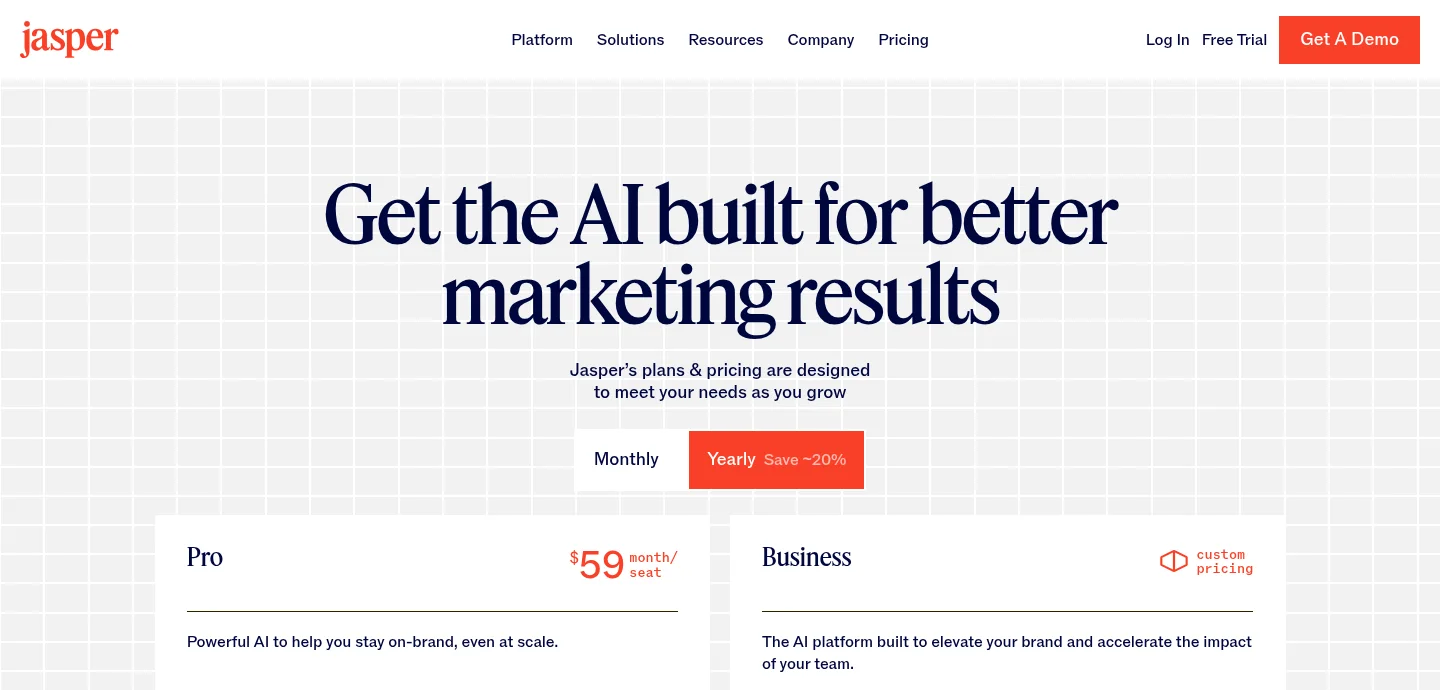
- Best for brand-consistent marketing copy at scale: Jasper, but at $59/month per seat it only makes sense as a team tool.
- Best for fixing writing you already did: Grammarly at $12/month. The cheapest real improvement on this page.
- You almost certainly need two tools: one to think with, one to polish with. Buying a third is where money starts being wasted.
The best AI for writing in 2026 is Claude if you care how the sentences read, and ChatGPT if you care about everything surrounding the sentences — research, outlines, repurposing, titles. For marketing teams producing volume against a brand guide, Jasper is the specialist. For cleaning up what you already wrote, Grammarly does more per dollar than anything else here.
Here is what each is genuinely best at, what it really costs, and who should skip it. Part of our AI writing tools hub.
The best AI writing tools compared
| Tool | Best for | Free tier | Price (Aug 2026) |
|---|---|---|---|
| Claude | Prose quality, revision, long documents | Yes | Pro $17/mo annual ($20 monthly) |
| ChatGPT | Outlining, research, all-round | Yes | ~$20/mo Plus |
| Jasper | Brand-consistent marketing copy | 7-day trial | Pro $59/mo per seat (yearly) |
| Grammarly | Editing what you already wrote | Yes | Pro $12/mo |
| Gemini | Writing inside Google Workspace | Yes | Google AI Pro $19.99/mo |
| QuillBot | Paraphrasing and tightening | Yes | ~$8.33/mo annual |
1. Claude — best for the writing itself
If the output is going to be read by humans who care about writing, Claude is the pick. It holds a register rather than drifting into corporate-neutral, handles dialogue and rhythm better than the alternatives, and — the underrated part — gives revision notes that read like an editor rather than a checklist. Ask it what is weakest about a draft and it will tell you something useful.
Long documents are its other strength: it holds a whole manuscript or report in context without losing the thread halfway through.
Real pricing: a usable free tier; Pro at $17/month on annual billing ($200 up front), or $20 if billed monthly; Max from $100/month for heavy use, as of August 2026. Note that the widely-quoted “$20” is the monthly rate — annual is cheaper.
Who should skip it: anyone whose main need is web research with citations, or who wants image generation in the same tool.
2. ChatGPT — best all-rounder
ChatGPT is the better tool for everything that is not the prose: outlining, brainstorming angles, research, summarising sources, generating titles and meta descriptions, repurposing one piece into five. It also has the widest ecosystem — custom instructions, file handling, image generation in the same subscription.
Its writing is competent and slightly generic. That is fine for most business writing and noticeable in anything with a voice.
Real pricing: free tier available; Plus around $20/month. See ChatGPT vs Claude for the direct comparison and ChatGPT alternatives for the rest.
3. Jasper — best for teams writing to a brand guide
Jasper is not competing with the chatbots on raw writing quality; it is competing on consistency. You train it on your brand voice, and it produces campaign copy, landing pages and ad variants that stay on-message across a team of people who would otherwise all sound different.
Real pricing: Pro at $59/month per seat on yearly billing, with Business at custom pricing, as of August 2026. There is a 7-day free trial and no free tier.
Who should skip it: solo writers and anyone under about five pieces of marketing copy a week. At $59 per seat you are paying for brand governance — if there is no brand to govern, a $20 chatbot does the same job. Our Jasper review has the detail.
4. Grammarly — best value on this page
Grammarly does the least and is the easiest to justify. It works everywhere you type, catches the errors you stop seeing in your own writing, flags tone mismatches, and rewrites clunky sentences on request.
Real pricing: a genuinely useful free tier; Pro at $12/month with a 7-day free trial and no payment up front, as of August 2026.
Who should skip it: nobody writing professionally, honestly. At $12 it is the cheapest improvement available. See our Grammarly review and what Grammarly’s AI actually does.
5. Gemini and QuillBot — the situational picks
Gemini earns its place if your work lives in Google Docs, Gmail and Sheets — the AI is in the document rather than in another tab. Google AI Pro runs $19.99/month as of August 2026 and bundles storage. See Gemini vs ChatGPT.
QuillBot is the paraphrasing specialist — tightening, rewording, adjusting formality — at about $8.33/month billed annually. Narrow, cheap, good at its one job. See our QuillBot review.
Which combination should you actually buy?
- Blogger or freelance writer: Claude + Grammarly. About $29/month, covers everything.
- Marketer at a company: ChatGPT + Grammarly, adding Jasper only if a team shares a brand voice.
- Student or academic: Claude free tier + Grammarly free tier. Pay for nothing until you hit a wall.
- Google Workspace shop: Gemini + Grammarly.
- Fiction: a fiction-tuned tool instead — see best AI tools for writers.
- You just need text that does not read as AI: that is an editing problem, not a tool problem — see best AI humanizers.
The three limits that decide whether this is usable
Voice flattening. Every one of these tools pulls prose toward the same fluent middle. Accept enough suggestions and your writing becomes competent and forgettable. Use AI for structure, problems and revision notes; write the sentences that carry your voice yourself.
Facts. All of them will produce a confident, plausible, wrong statistic. Anything with a number, a date, a name or a claim needs checking against a source before it is published. This is not a solved problem in 2026 and treating it as one is how brands end up issuing corrections.
Disclosure and policy. If you publish for clients, in academia, or on platforms with AI rules, the requirements differ and they change. Check the current policy where you are publishing rather than assuming.
Bottom line
Claude writes the best sentences and gives the best editorial feedback, at $17/month on annual billing. ChatGPT is the better thinking partner for everything around the draft. Grammarly at $12/month is the cheapest genuine upgrade to writing you are already doing, and Jasper at $59/seat only pays back when a team needs one voice. Start with one chatbot and Grammarly for a month; that combination solves the problem for most people, and you will know quickly whether you need anything else.
More in the AI writing tools hub.
FAQ
What is the best AI for writing in 2026? Claude produces the most natural prose and the best revision feedback. ChatGPT is the stronger all-rounder for outlining and research, Jasper is best for brand-consistent marketing copy at team scale, and Grammarly is best for editing writing you already produced.
What is the best free AI for writing? Claude and ChatGPT both have usable free tiers, and Grammarly’s free plan covers grammar, clarity and tone. Most writers can work productively without paying at first.
How much does Claude cost? Free for the basic tier. Pro is $17 per month billed annually ($200 up front) or $20 billed monthly, and Max starts at $100 per month, as of August 2026.
Is Claude or ChatGPT better for writing? Claude for the writing itself — tone, rhythm, dialogue and editorial notes. ChatGPT for the work around it: research, outlines, titles, repurposing, and image generation in the same subscription.
Will AI writing be detected? Detection tools are unreliable in both directions, so the practical concern is different: unedited AI prose reads generic to human readers. Rewriting the opening and adding specific detail matters more than trying to beat a detector.
Can AI writing tools be trusted with facts? No. Every tool here will state a wrong figure confidently. Verify any number, date, name or claim against a source before publishing.