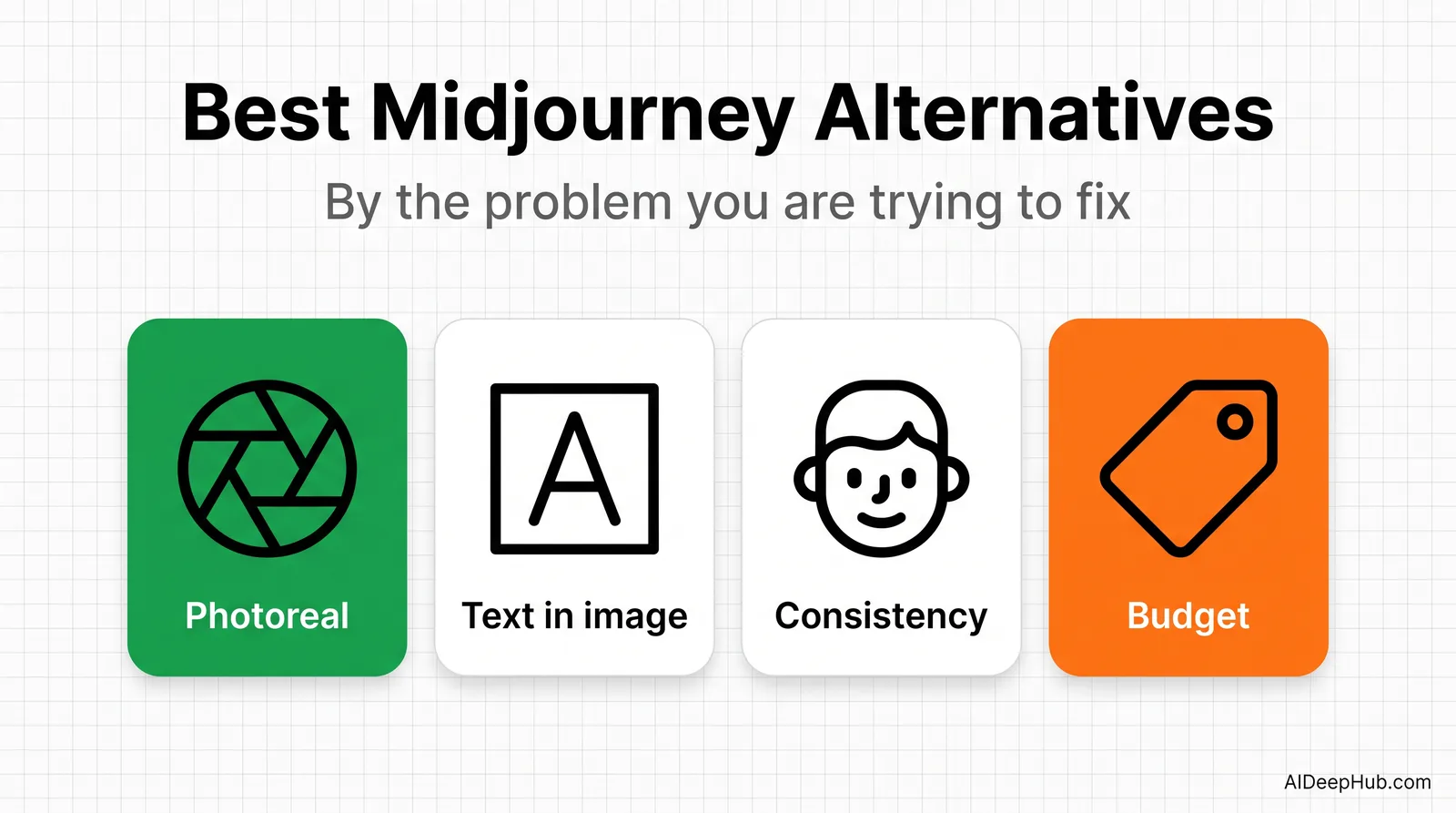
- Best for photorealism: Flux — the benchmark in 2026, and available through APIs at roughly $0.06 an image.
- Best when the image has text: Ideogram. Midjourney is famously poor at legible typography; this is the clearest reason to switch.
- Best for consistent characters: Leonardo, thanks to fine-tunes and reference control.
- Best free: Google’s Gemini image models and Playground both have genuinely generous free access.
- A real reason people leave: Midjourney has no public pricing page — you cannot compare costs before signing up, and there is still no official API.
People look for Midjourney alternatives for three reasons: it costs more than they want, it cannot render readable text, or they need an API and Midjourney does not offer one. Which alternative is right depends entirely on which of those three is your problem.
Here is the honest map, by what you are actually trying to fix. Part of our AI image tools hub.
midjourney.com/pricing returns a 404, and plan costs are only visible after you sign in. Figures circulating for Midjourney’s tiers come from third parties, not the vendor, so we do not quote them as fact here.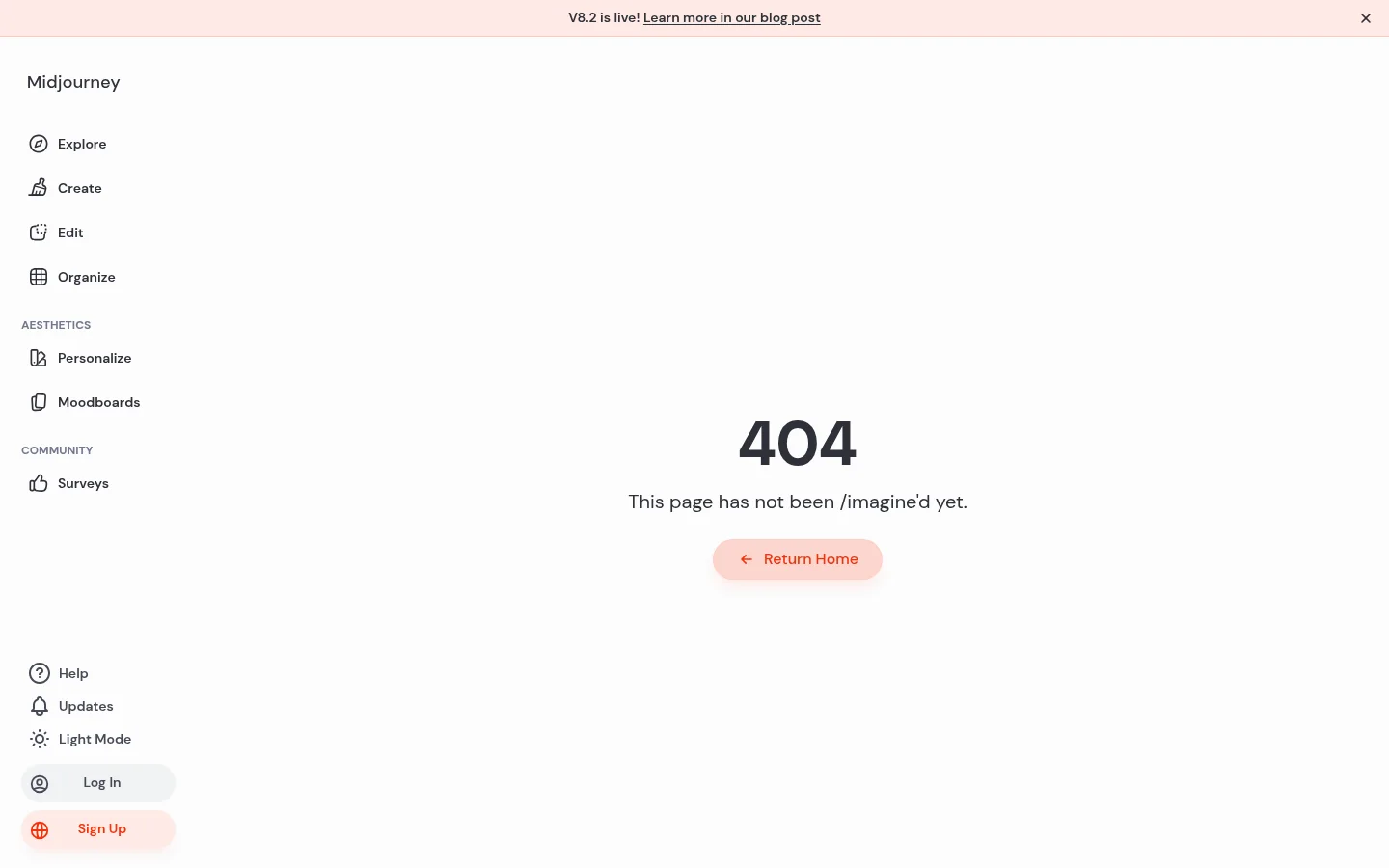
Why people leave Midjourney
- Text in images. Midjourney’s typography accuracy is far behind Ideogram’s. If your work is posters, ads, packaging or anything with words in the frame, this alone is disqualifying.
- No official API. You cannot build Midjourney into a product or pipeline. Flux, Ideogram and Stable Diffusion all offer proper APIs.
- Opaque pricing. No public pricing page means no cost comparison before you commit — unusual in this category and a genuine friction point.
- Character consistency. Midjourney is superb at a single striking image and weaker at the same character across 50 shots.
- No free tier. Several competitors let you evaluate output quality at no cost. Midjourney does not.
What Midjourney still wins at is the aesthetic ceiling. For a single hero image that has to look extraordinary, it remains the benchmark — see our Midjourney review.
The best Midjourney alternatives compared
| Tool | Best for | API? | Free tier | Price (Aug 2026) |
|---|---|---|---|---|
| Flux | Photorealism, production pipelines | Yes | Via platforms | ~$0.06/image on Pro tiers |
| Ideogram | Text and typography in images | Yes | Yes (daily limit) | From ~$7/mo |
| Leonardo | Character consistency, game and concept art | Yes | Yes (daily credits) | ~$10 / $24 / $48 per month |
| Google Gemini image | Fast edits and conversational iteration | Yes | Yes | In Google AI plans from $4.99/mo |
| Adobe Firefly | Commercially safe output | Yes | Limited | In Adobe plans |
| NightCafe / Playground | Budget and experimentation | Varies | Generous | From ~$6/mo |
1. Flux — best for photorealism
Flux from Black Forest Labs is the photorealism benchmark in 2026. Clean skin, believable lighting, plausible textures, and — critically for production work — it runs through APIs from several hosting platforms at roughly $0.06 per image on the Pro tiers. That per-image economy makes it the standard backend when you need volume rather than one hero shot.
Skip it if you want a polished consumer app with a gallery and community. Flux is a model, accessed through other people’s interfaces.
2. Ideogram — best for text in images
This is the specialisation that matters most. Ideogram renders readable, correctly-spelled text inside images at accuracy Midjourney does not approach. Posters, social ads, app screenshots, packaging, book covers — anything where a word has to be right.
It is also the cheapest credible entry point, from around $7/month, with a free tier covering roughly ten prompts a day.
Skip it if your work is character art or photorealistic scenes. Outside typography it is good, not class-leading.
3. Leonardo — best for consistent characters
Leonardo’s fine-tunes and reference controls make it the strongest option when the same character, product or style has to appear across many images — game assets, concept art, comic panels, brand mascots. Tiers run roughly $10, $24 and $48 per month, with a free daily credit allowance and no watermark on most plans.
Skip it if you need one striking image rather than fifty consistent ones. See our Leonardo AI review.
4. Google’s Gemini image models — best free option
Google’s image generation is fast, strong on character consistency across edits, and unusually good at conversational refinement — you describe a change and it applies it rather than regenerating from scratch. Access comes through the Google AI plans, which start at $4.99/month, with meaningful free usage.
Skip it if you want the artistic ceiling. It is the practical choice, not the aesthetic one.
5. Adobe Firefly — best for commercial safety
If a lawyer will ever ask where the image came from, Firefly is the answer: trained on licensed material with commercial-use terms, and integrated into Photoshop and Illustrator. Agencies and in-house teams pick it for that reason alone.
6. NightCafe and Playground — best on a budget
Both run several models behind one interface with generous free tiers, from around $6/month paid. The right place to experiment before deciding which model you actually want.
Which alternative fixes your problem?
- “The text comes out garbled”: Ideogram.
- “I need photorealism”: Flux.
- “I need it in my product / at volume”: Flux or Ideogram via API.
- “The same character keeps changing”: Leonardo.
- “It’s too expensive”: Google’s Gemini image models, NightCafe or Playground.
- “Legal needs to approve it”: Adobe Firefly.
- “I just want the best-looking single image”: stay on Midjourney. Nothing here beats it on pure aesthetics.
Before you switch
Two practical notes. First, prompts do not transfer cleanly. Midjourney’s parameter syntax and its house aesthetic mean a prompt tuned there produces different results elsewhere. Budget an afternoon of re-learning, not five minutes.
Second, check commercial rights per tool and per tier, especially on free plans. Several of these restrict commercial use at no cost, and the terms have changed more than once in the past year.
Bottom line
Switch to Ideogram if your images contain text, Flux if you need photorealism or an API, and Leonardo if the same character has to appear repeatedly. If cost is the issue, Google’s image models and Playground both give you enough free capacity to work. And if none of those is your problem — if you simply want the best-looking image and you are happy paying — Midjourney is still the one to beat.
More in the AI image tools hub, or see best AI art generators.
FAQ
What is the best Midjourney alternative? Flux for photorealism, Ideogram for images containing text, and Leonardo for consistent characters. Google’s Gemini image models are the best free option. The right choice depends on which Midjourney limitation you are trying to escape.
Is there a free Midjourney alternative? Yes. Ideogram, Leonardo, NightCafe and Playground all have free tiers with daily credits, and Google’s image models offer meaningful free usage. Midjourney itself has no free tier.
How much does Midjourney cost? Midjourney does not publish a public pricing page — the URL returns a 404 and plan costs appear only after you sign in. Figures quoted elsewhere come from third parties, so check in-app before subscribing.
Does Midjourney have an API? No official one. If you need to build image generation into a product or pipeline, Flux, Ideogram and Stable Diffusion all offer proper APIs.
Which AI image generator is best for text in images? Ideogram, by a wide margin. Its typography accuracy is far ahead of Midjourney’s, which is the single most common reason people switch.
Is anything better than Midjourney for quality? For pure aesthetic ceiling on a single image, Midjourney is still the benchmark. Flux beats it on photorealism, Ideogram on text, and Leonardo on character consistency.