- Most working writers use two tools, not one: a general chatbot for thinking, and one specialist for the actual manuscript.
- Best for fiction: Sudowrite — the only major tool trained specifically on prose rather than marketing copy.
- Best for long series and world-building: NovelCrafter — its Codex is what stops continuity errors in book four.
- Best for editing your own writing: ProWritingAid or Grammarly. This is where AI helps most and hurts your voice least.
- Best value: Claude or ChatGPT alone. For many writers a $20 chatbot replaces three specialist subscriptions.
The best AI tools for writers in 2026 split by job, not by quality. Sudowrite is the strongest dedicated fiction tool, NovelCrafter is the one serious novelists keep for multi-book projects, Claude and ChatGPT are the best general-purpose partners for outlining and revision, and ProWritingAid or Grammarly handle the editing pass without flattening your voice.
What follows is who each one is for, what it costs, and — the part most roundups avoid — where AI writing tools actively make writing worse. Part of our AI writing tools hub.
The best AI tools for writers compared
| Tool | Best for | Type | Free tier | Price (Aug 2026) |
|---|---|---|---|---|
| Sudowrite | Fiction prose and scene writing | Specialist | Trial, no card | $10-$44/mo (yearly) |
| NovelCrafter | Series, world-building, continuity | Specialist | Limited | Subscription tiers |
| Claude | Prose quality, revision, dialogue | General | Yes | ~$20/mo Pro |
| ChatGPT | Outlining, research, all-round | General | Yes | ~$20/mo Plus |
| ProWritingAid | Deep self-editing reports | Editing | Limited | Subscription / lifetime |
| Grammarly | Everyday clarity and tone | Editing | Yes | Free; paid tiers |
| Jasper | Marketing copy and brand voice | Commercial | Trial | Subscription |
1. Sudowrite — best for fiction
Sudowrite is the only major AI writing tool built for novelists rather than marketers, and it shows. Its Muse model is fine-tuned on storytelling prose, and the feature set maps to how fiction is actually written: Describe expands sensory detail, First Draft turns an outline into rough prose, and Story Bible keeps characters, settings and plot threads consistent across a manuscript.
The practical difference reported by writers testing it against general chatbots is less time fighting the model. General assistants sanitise darker or emotionally intense scenes and drift toward tidy resolutions; a fiction-tuned model does that less.
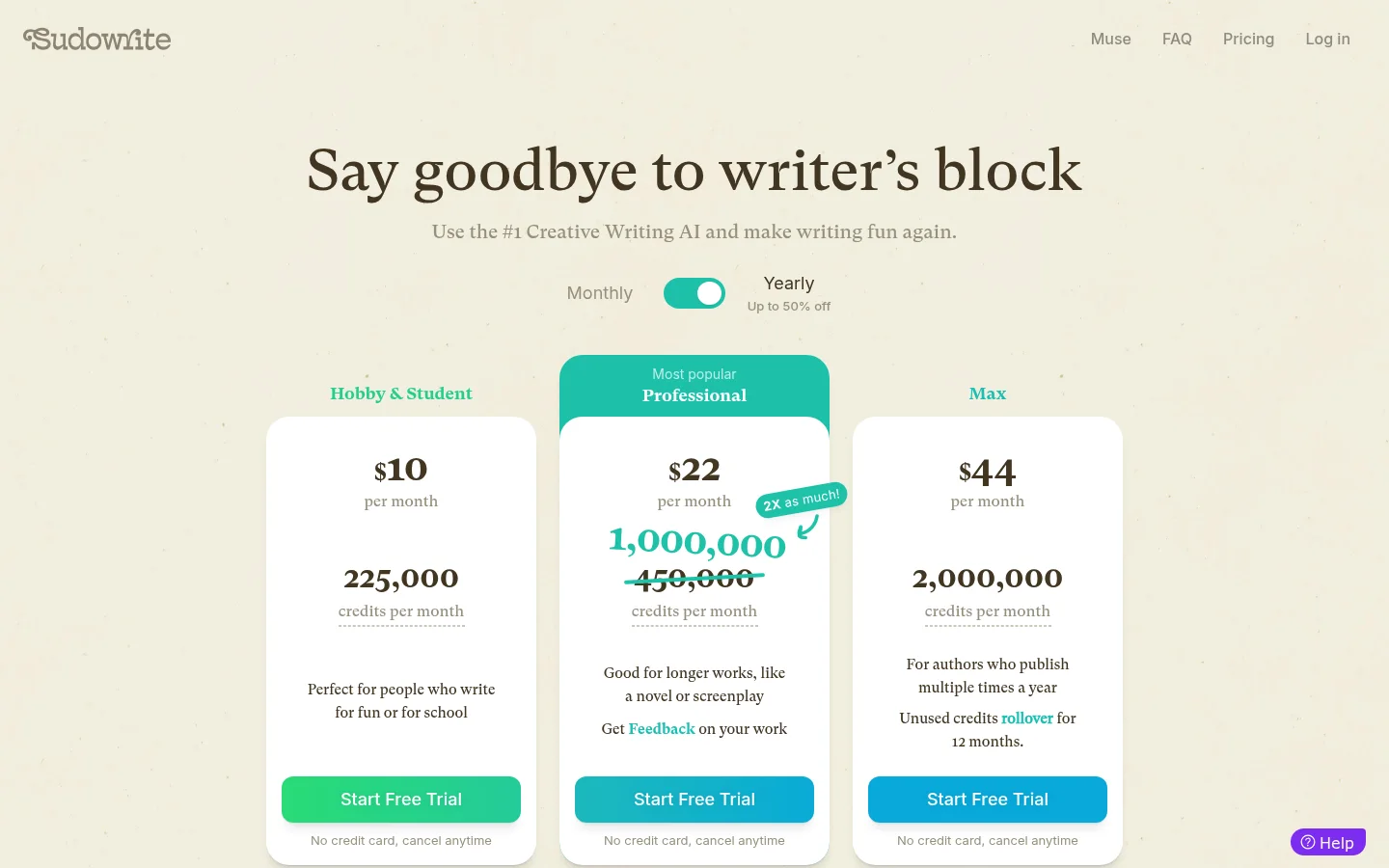
Real pricing: free trial with no card required, then three tiers billed yearly, as of August 2026: $10/month (Hobby & Student, 225,000 credits), $22/month (Professional, 1,000,000 credits) and $44/month (Max, 2,000,000 credits). The tiers differ by credit allowance, not features, so heavy drafting is what pushes you up.
Who should skip it: non-fiction writers, bloggers and copywriters. You would be paying for scene-writing tools you never open — Jasper or a general chatbot serves you better.
2. NovelCrafter — best for long projects and series
NovelCrafter is closer to professional writing software with AI attached than an AI tool with an editor attached. Its Codex stores characters, locations, factions and lore, and feeds the relevant entries to the model as you write — which is the mechanism that prevents the continuity errors that plague long AI-assisted projects. It also lets you bring your own model, so you are not locked to one vendor’s pricing.
Who should skip it: anyone writing a single standalone book or shorter. The setup overhead only pays back across a large, complex project.
3. Claude and ChatGPT — the best value in the category
For a large share of writers, a single general chatbot subscription replaces everything else on this list.
Claude is the stronger prose partner: better at dialogue, tone matching, spotting plot holes, and giving revision notes that read like an editor rather than a checklist. ChatGPT is the better all-rounder for outlining, research, brainstorming and marketing material around the book.
Both are around $20/month with usable free tiers. Our ChatGPT vs Claude comparison covers the split in detail, and ChatGPT alternatives covers the rest of the field.
Who should skip them: nobody, honestly. Even writers who buy a specialist tool keep one of these open alongside it. Start here before buying anything else.
4. ProWritingAid and Grammarly — best for editing
This is where AI helps most and risks your voice least, because you are improving text you already wrote rather than generating text you did not.
ProWritingAid produces deep reports — pacing, sticky sentences, overused words, dialogue tags, echo detection. It is built for manuscript-length work and it is the tool that will tell you that you used “just” 340 times.
Grammarly is faster and shallower: clarity, tone, correctness, everywhere you type. Better for blogging, email and client work than for novels. See our Grammarly review and what Grammarly’s AI actually does.
Who should skip them: writers already working with a human editor on the same pass. Two sets of notes on one draft is a good way to write nothing.
5. Jasper and the marketing-copy tools
Jasper, Copy.ai and Writesonic are built for brand voice, ad copy, landing pages and volume content — not manuscripts. If your writing income comes from client copy rather than books, this is your category, and brand-voice training is the feature that justifies the price. See our reviews of Jasper, Copy.ai and Writesonic.
Which tools should you actually buy?
- Novelist, one book: Claude + Sudowrite trial. Add ProWritingAid at the revision stage.
- Novelist, a series: NovelCrafter + Claude.
- Blogger or content writer: ChatGPT or Claude + Grammarly. That is the whole stack.
- Copywriter with clients: Jasper for brand voice, plus a chatbot for everything else.
- Academic or non-fiction: Claude for structure, ProWritingAid for the edit, and a citation tool. See our citation generator guide.
- Just starting: one chatbot free tier. Spend nothing for a month and find out what you actually reach for.
Where AI writing tools make writing worse
Four failure modes worth naming, because every one of them is common.
Voice flattening. Accept enough suggestions and your prose converges on the same competent, frictionless register as everyone else’s. The tell is that nothing is bad and nothing is memorable. Use AI for structure and problems, not for sentences you could write yourself.
Premature drafting. Generating prose before you know what the scene is for produces pages that read fine and do nothing. Outline first; the tool is far better at helping you think than at helping you type.
Continuity drift. Any long project generated in chunks accumulates contradictions. This is exactly the problem Story Bible and Codex exist to solve, and if you are not using one of them, you are creating work for your future self.
Publishing platform rules. If you sell your book, disclosure requirements vary by retailer and change. Check the current policy of the platform you are publishing on before you upload — not after.
Bottom line
Start with Claude or ChatGPT and nothing else for a month. Most writers discover that covers outlining, revision and problem-solving, which is where AI genuinely helps. Add Sudowrite if you write fiction and want prose generation tuned for it, NovelCrafter if you are building a series, and ProWritingAid when you reach the editing pass. Buy the fourth tool only after the first three have proven they save you hours.
More in the AI writing tools hub, or see best AI story generators if fiction is your focus.
FAQ
What are the best AI tools for writers in 2026? Sudowrite for fiction prose, NovelCrafter for series and world-building, Claude or ChatGPT as an all-round writing partner, and ProWritingAid or Grammarly for the editing pass.
What is the best AI tool for fiction writing? Sudowrite, because its Muse model is fine-tuned specifically on storytelling prose and its Story Bible keeps characters and plot consistent across a manuscript. General chatbots tend to sanitise emotionally intense scenes.
Is there a free AI tool for writers? Yes. ChatGPT, Claude and Grammarly all have usable free tiers, and Sudowrite offers a trial without a credit card. Most writers can work productively without paying for anything at first.
Will AI writing tools ruin my voice? They can, if you accept suggestions at the sentence level. Prose converges on a generic register when over-edited by AI. Use these tools for structure, revision notes and problem-solving, and write the sentences yourself.
Do I need to disclose AI use when publishing a book? Requirements vary by retailer and platform, and they have changed more than once. Check the current policy of the store you are publishing to before uploading.
Can one AI tool replace all of these? For bloggers and non-fiction writers, usually yes — a single chatbot plus a grammar checker covers the work. Fiction writers running long projects benefit from a specialist tool that tracks continuity.