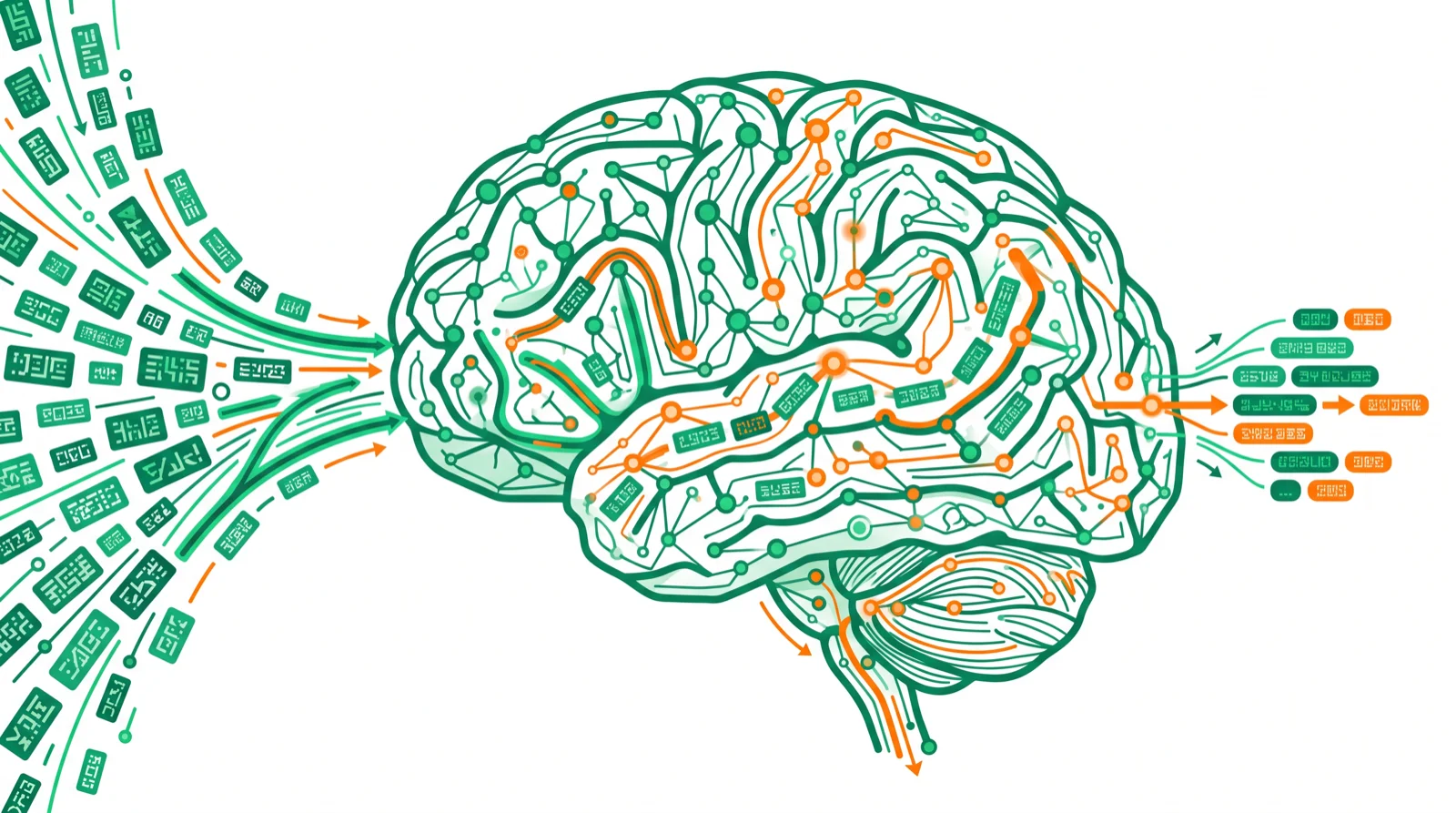
- An LLM (large language model) is the AI that powers ChatGPT, Claude, and Gemini — it predicts text.
- It learns patterns from huge amounts of text, then generates human-like language one word at a time.
- LLMs are powerful but can “hallucinate” — state wrong things confidently — so verify anything important.
“LLM” is everywhere in AI news, but what does it actually mean? This guide explains large language models in plain English: what they are, how they work, examples, what they’re good and bad at.
Part of our AI chatbots & assistants hub.
What is an LLM?
LLM stands for large language model. It’s an AI trained on enormous amounts of text to understand and generate human language. When you chat with ChatGPT, Claude, or Gemini, an LLM is the engine underneath — reading your words and producing a response. “Large” refers to the huge amount of data and the billions of internal settings (parameters) it learns.
How do LLMs work?
At their core, LLMs do one thing surprisingly well: predict the next word. Trained on vast text, a model learns which words tend to follow others, in context. Given your prompt, it generates a response one token (word-piece) at a time, each choice informed by everything before it. Do that billions of times over huge data and the result feels like understanding — even though it’s sophisticated pattern prediction.
Examples of LLMs
- GPT (OpenAI) — powers ChatGPT.
- Claude (Anthropic) — known for writing and reasoning.
- Gemini (Google) — built into Google apps.
- Llama (Meta) — a leading open-weight model you can run yourself.
Compare the assistants they power in our best AI chatbots guide.
What are LLMs used for?
- Writing & editing — drafts, summaries, rewrites.
- Answering questions and explaining concepts.
- Coding — generating and debugging code.
- Powering AI agents that plan and act. See what is an AI agent.
Limitations of LLMs
LLMs don’t “know” facts the way a database does — they predict plausible text. That means they can hallucinate: state something false with total confidence. They also have a knowledge cutoff (unless connected to live search) and can reflect biases in their training data. Treat their output as a smart first draft to verify, not gospel.
Bottom line
An LLM is the large language model that powers today’s AI assistants — a system trained to predict and generate human-like text. They’re remarkably capable for writing, answering, and coding, but they can confidently get things wrong, so always verify what matters. Explore the tools they power in our AI chatbots hub.
FAQ
What is an LLM in AI? A large language model — an AI trained on huge amounts of text to understand and generate human language. It powers tools like ChatGPT, Claude, and Gemini.
How does an LLM work? It predicts the next word (token) based on patterns learned from vast text, generating a response one piece at a time in context.
What are examples of LLMs? GPT (ChatGPT), Claude, Gemini, and open models like Llama.
What’s the difference between an LLM and AI? AI is the broad field; an LLM is one type of AI focused on language. Chatbots and many AI tools are built on top of LLMs.
Why do LLMs make mistakes? They predict plausible text rather than looking up facts, so they can hallucinate — state wrong things confidently. Always verify important answers.
🧰 More: AI chatbots · Best AI chatbots · What is an AI agent?
