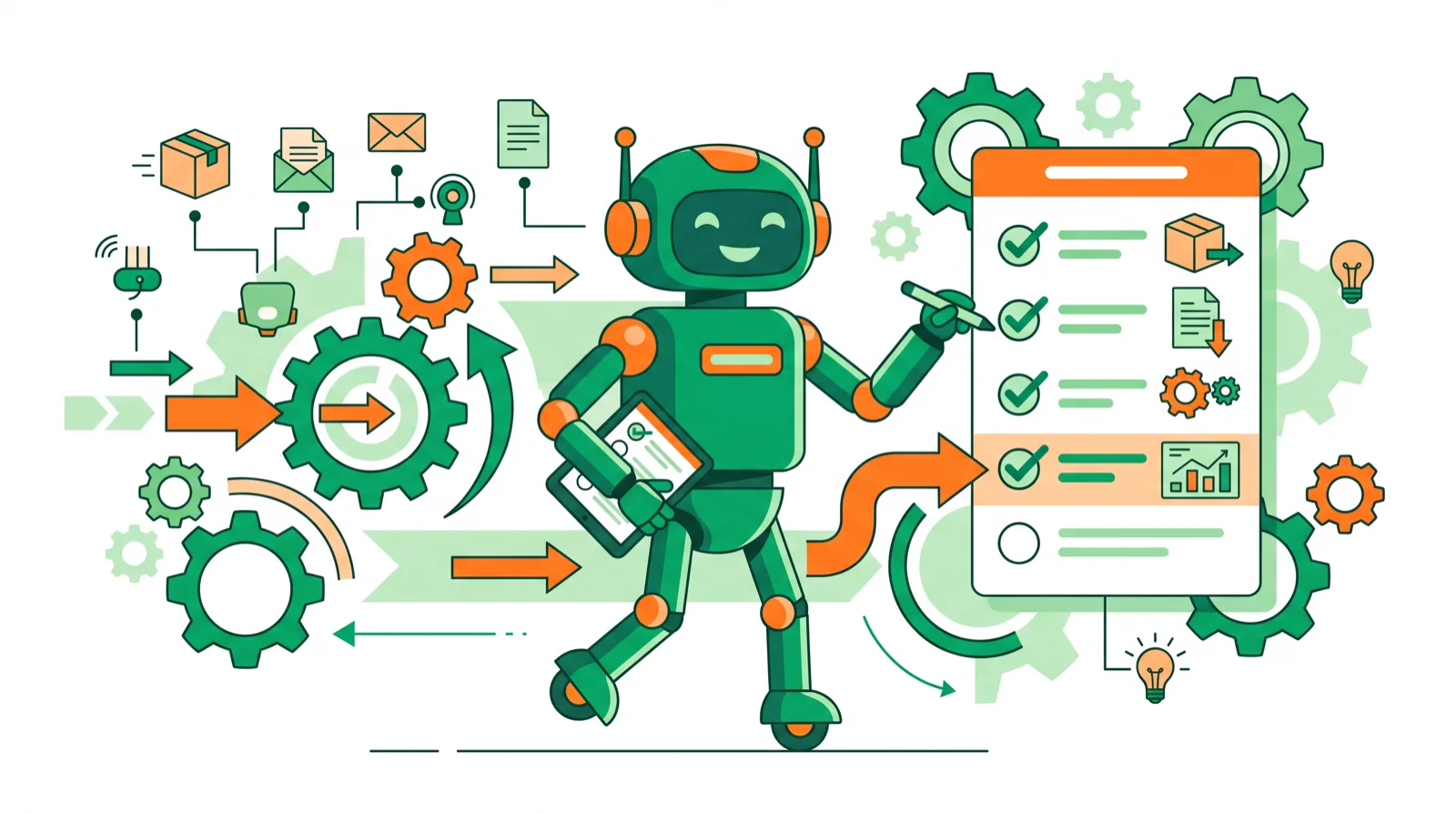
- An AI agent is an AI that takes a goal and acts on its own — it plans, uses tools, and completes multi-step tasks.
- The difference from a chatbot: a chatbot answers; an agent does (books, buys, codes, updates records).
- 2026 examples: Claude Code, ChatGPT agents, customer-service agents, and no-code builders like Lindy and Zapier.
“AI agent” is the biggest AI buzzword of 2026 — but what actually is one? This guide explains AI agents in plain English: what they are, how they work, real examples, and how to try one yourself.
Part of our AI automation & agents hub.
What is an AI agent?
An AI agent is a system that pursues a goal on its own. You give it an objective (“book the cheapest flight,” “fix this bug,” “chase these overdue invoices”) and it figures out the steps, takes actions using tools and apps, checks the results, and adjusts — with little or no hand-holding. It’s built on a large language model (the “brain”) plus the ability to plan and act.
Agent vs chatbot: what’s the difference?
A chatbot responds to your message. An agent takes action to reach a goal. Ask a chatbot to “book a meeting” and it tells you how; ask an agent and it checks calendars, sends the invite, and confirms. The move from answering to doing is the whole point of agents.
How AI agents work (in 4 steps)
- Perceive: read the goal and gather context (your files, the web, an app’s data).
- Plan: break the goal into steps.
- Act: use tools — browse, run code, call an API, update a record.
- Reflect: check the result, fix mistakes, and repeat until done.
That loop — plan, act, check — is what makes an agent more than a text generator.
Real examples of AI agents in 2026
- Coding: Claude Code and OpenAI Codex explore a codebase, edit files, run tests, and commit. See agentic coding tools.
- General tasks: ChatGPT’s agent mode can browse and complete web tasks for you.
- Customer service: agents answer tickets, look up orders, and process refunds.
- Business automation: no-code builders like Lindy, Zapier, and Relevance AI let you build agents for email, sales, and ops.
What can (and can’t) AI agents do?
Today’s agents are strong at bounded, tool-based tasks — research, coding, data entry, scheduling, first-line support. They still struggle with very long, ambiguous goals, and they make mistakes, so they need guardrails and human review for anything important. Think capable intern, not autonomous employee.
How to try an AI agent
- Coding: try Claude Code or Cursor’s agent on a small task.
- Business: build a simple agent in Lindy or Zapier to handle one repetitive job.
- General: use ChatGPT’s agent mode for a multi-step web task.
- Start small, keep a human in the loop, and expand what you trust it with.
Bottom line
An AI agent is AI that acts, not just answers — it takes a goal, plans, uses tools, and gets it done. In 2026 they’re already useful for coding, support, and business automation, as long as you supervise them. Explore the tools in our AI automation hub and the best AI agents roundup.
FAQ
What is an AI agent? An AI system that takes a goal and completes it on its own by planning, using tools, and acting across multiple steps — not just answering a question.
What’s the difference between an AI agent and a chatbot? A chatbot responds to messages; an agent takes actions to reach a goal, like booking, buying, coding, or updating records.
What are examples of AI agents? Claude Code and Codex for coding, ChatGPT’s agent mode for web tasks, customer-service agents, and no-code builders like Lindy and Zapier.
How do AI agents work? They perceive the goal and context, plan the steps, act using tools, then check and correct until the task is done.
Are AI agents safe? They’re useful with supervision. Because they can take real actions and make mistakes, keep a human in the loop and add guardrails for anything important.
🧰 More: AI automation tools · Best AI agents · Agentic AI coding tools
