- Google explicitly lists “using generative AI tools or other similar tools to generate many pages without adding value for users” as scaled content abuse, a spam policy violation.
- Article Forge’s headline features are bulk generation and automatic posting to blogs. That’s the pattern the policy describes.
- “Passes Copyscape” is not a quality signal. It means the text isn’t copied. It says nothing about whether it’s worth reading or will rank.
- Pricing is $13/mo annually or $27 monthly for 25,000 words, with a 5-day trial and a conditional 30-day refund.
Article Forge is one of the original automated article writers. You give it a keyword, it produces a complete article of 1,500 words or more without further input, and it can publish that article to your blog on a schedule.
In 2020 that was a compelling pitch. This review is about whether it still is, and the honest answer depends entirely on what you’re planning to do with the output.
What is Article Forge?
Article Forge is an AI content generator built around volume and automation rather than collaboration. Where a modern assistant expects you to steer, edit and iterate, Article Forge is designed to run without you.
Its advertised feature set tells you exactly who it’s for: bulk article generation, automatic posting to blogs, API access, and content that passes Copyscape. Those are the tools of someone filling a lot of pages quickly.
How much does Article Forge cost?
Prices below were read from Article Forge’s pricing page on 10 August 2026.
| Plan | Annual | Monthly | Included |
|---|---|---|---|
| Standard | $13/mo | $27/mo | 25,000 words/mo, 1 user |
| Standard (scaled) | Rises with volume | Slider runs from 25,000 up to 500,000 words/mo | |
| Business | Contact sales | 500,000+ words, custom users, dedicated account manager | |
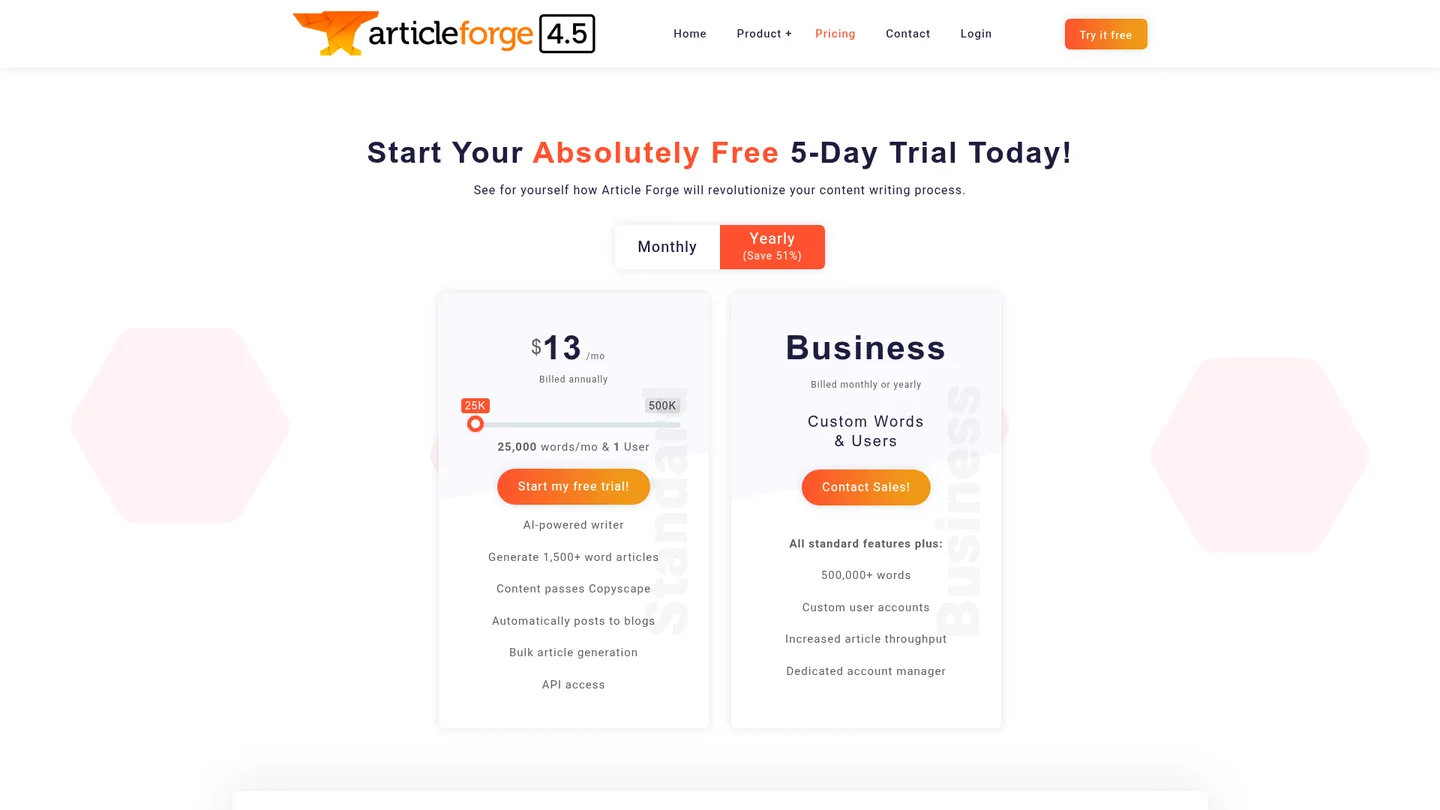
There’s a 5-day free trial, and a 30-day money-back guarantee that applies if you’ve generated fewer than ten articles. Read that condition before you test it at volume, because generating a batch to evaluate the quality is exactly what would void the refund.
Google’s scaled content abuse policy is the problem
This is the section that should decide your purchase, and it has nothing to do with the software’s quality.
Google’s published spam policies for web search define scaled content abuse as “when many pages are generated for the primary purpose of manipulating search rankings and not helping users.” The first example listed is:
“Using generative AI tools or other similar tools to generate many pages without adding value for users.”
The policy adds that it applies “no matter how it’s created”, which closes the loophole of arguing about which model produced the text. Sites found in violation “may rank lower in results or not appear in results at all.”
Now read Article Forge’s own feature list again: bulk article generation, automatic posting to blogs, API access. Those aren’t incidental features. They’re the product. Using it as designed produces the exact pattern the policy describes.
To be fair to the tool: AI-written content is not banned. Google’s position is about value and intent, not authorship. A single Article Forge draft that you then research, correct, add first-hand knowledge to and rewrite is not spam. But if you were going to do all that, you didn’t need a tool built for one-click volume.
What “passes Copyscape” actually means
Article Forge promotes the fact that its output passes Copyscape, and that claim gets repeated in a lot of reviews as though it settles the quality question.
It doesn’t. Copyscape detects duplication. Passing it means the words aren’t copied from another page. It says nothing about whether the article is accurate, useful, current, or better than the ten results already ranking.
Uniqueness stopped being the bar years ago. Any language model produces unique text by default. What Google rewards now is evidence that a human with something to say was involved, and no plagiarism checker measures that.
Where it could still make sense
There are narrow cases where the model makes sense:
- First drafts you intend to rewrite substantially. If you genuinely treat the output as raw material, the volume pricing is competitive.
- Content that isn’t aimed at search at all. Internal documentation, product description variants, or copy behind a login carries no ranking risk.
- Ideation at scale. Generating structural outlines for a large content plan, then writing the articles yourself.
In each of those cases, though, a general-purpose AI assistant will give you better raw material for similar money and won’t tempt you into the automated-posting workflow.
Who should skip Article Forge?
Skip it if you want search traffic. This is the main case, and it covers most buyers. The workflow the tool is built around is the workflow Google’s policy targets.
Skip it if you’re building a site you intend to keep. A penalty is far more expensive than the subscription saved.
Skip it if you want a writing partner. Article Forge is designed to run without you. If you want to draft, refine and edit collaboratively, this is the wrong shape of tool.
Skip it if you’re in a field where accuracy matters. Unsupervised generation on health, finance or legal topics is a liability, not a shortcut.
For alternatives that fit a modern workflow, see our AI writing tools hub.
Bottom line: is Article Forge worth it in 2026?
For search-focused content, no. Not because the software fails at its job, but because its job is one Google now explicitly penalises. The economics that made bulk generation attractive assumed the pages would rank, and that assumption no longer holds.
For non-search content, maybe, but check the alternatives first. At $13/mo annually it’s cheap, and a general-purpose assistant at a similar price gives you more control and better raw text.
If you’re going to try it anyway, use the 5-day trial, stay under ten articles so the 30-day refund still applies, and judge the output by whether you’d publish it under your own name without editing. See Article Forge →
FAQ
How much does Article Forge cost in 2026? The Standard plan is $13 per month billed annually or $27 billed monthly, covering 25,000 words a month for one user. A slider scales the plan up to 500,000 words, and a Business tier above that is quoted by sales. Verified on articleforge.com/pricing on 10 August 2026.
Is Article Forge content safe for SEO? Used as designed, it carries real risk. Google’s spam policies list “using generative AI tools or other similar tools to generate many pages without adding value for users” as scaled content abuse, and Article Forge is built around bulk generation and automatic posting. AI-assisted content that a human genuinely improves is not against policy.
Does Article Forge content pass plagiarism checks? Yes, Article Forge states its output passes Copyscape. That only means the text isn’t duplicated from elsewhere. It’s not evidence of accuracy, usefulness or ranking potential, and any language model produces unique text by default.
Does Article Forge have a free trial? Yes, a 5-day free trial, plus a 30-day money-back guarantee that applies only if you’ve created fewer than ten articles. Generating a large test batch would void the refund.
What’s a better alternative to Article Forge? For content aimed at search, a general-purpose AI writing assistant used as a drafting partner, with your own research and editing on top, is both safer and better. See our AI writing tools guide for current options.
🧰 More: AI writing tools hub · All AI Tools · How we test
Pricing verified 10 August 2026; Google spam policy text quoted as published (page last updated 15 May 2026). Spotted something out of date? Tell us and we’ll fix it.
